What happens when you take words out of the equation? This animation project challenged us to tell a powerful, human story using nothing but sound, music and visuals.
The challenge: telling a story without words
This project set out to challenge harmful stereotypes about Cambodian miners, while sharing a more universal story of hard work, resilience and ambition.
There was an added twist: no script, no voiceover, just sound and visuals.
The animation needed to travel far and wide, primarily via WhatsApp and other messaging platforms, reaching rural communities across Cambodia. That meant it had to be instantly understandable, emotionally engaging, and accessible without relying on language.
What shaped our approach
Without dialogue to lean on, every creative choice had to work harder.
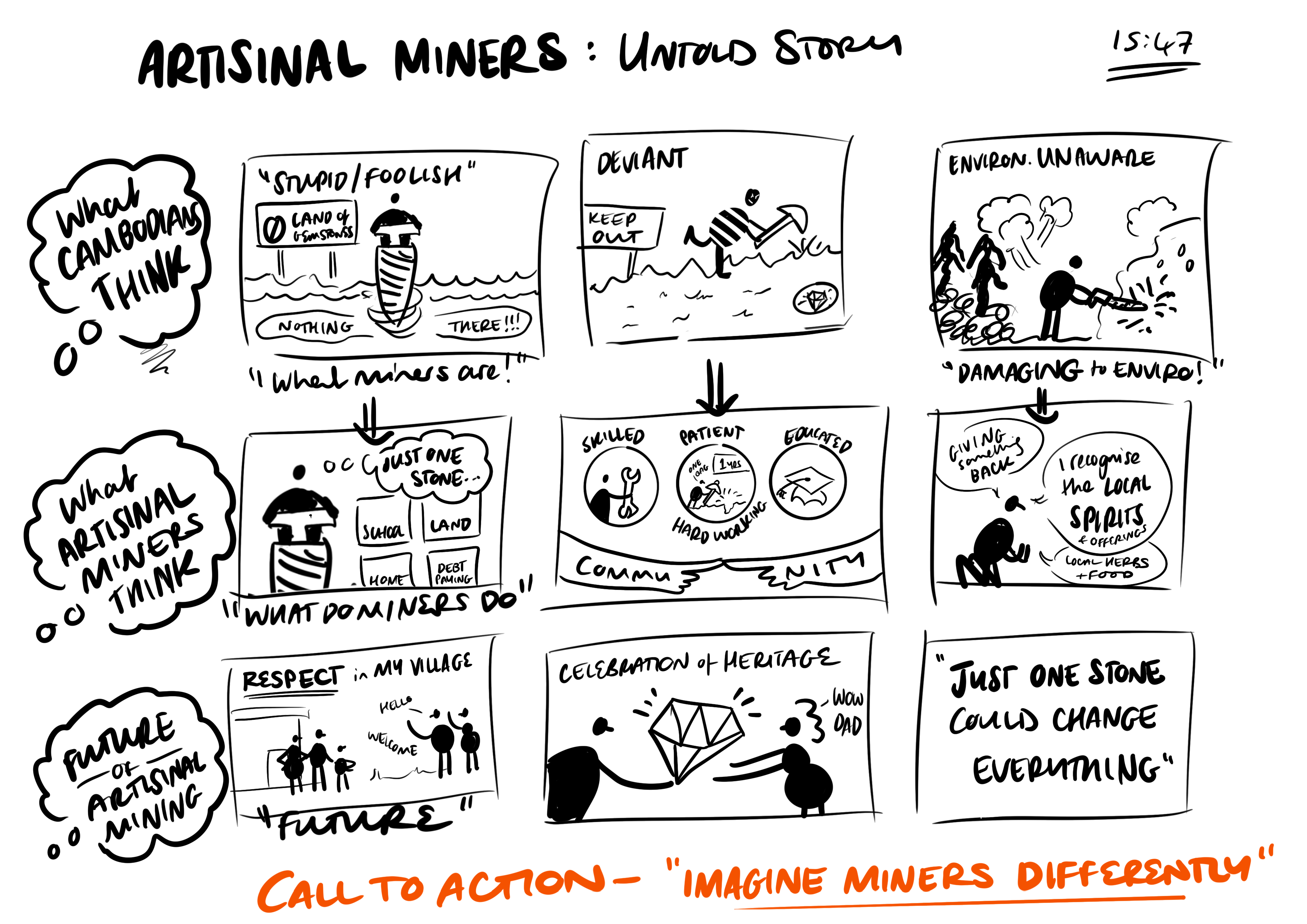
Caption: Discovery call notes where Laura and clients collaborated on the key narrative points we needed to hit in the animation.
We built a narrative that moves through time, exploring the Cambodian gemstone mining lifestyle before and after the war, and how gemstone mining has evolved over time. And a specific but common experience of one miner’s dreams, motivations and daily reality.
A key goal was to reframe perception. What might be seen from the outside as opportunistic or shady is, in reality, demanding and honest work driven by determination and purpose.
One of the most valuable parts of the process was collaborating with real gemstone miners in Cambodia. Throughout the storyboarding process the client shared with real miners to get their take and opinions which was then passed on to us. A few examples of their insight were the typical clothing they wore, being long sleeve t-shirt and trousers to keep themselves safe from Malaria and hearing which locations had different types of gemstones depending if it's at the bottom of a mountain or near the riverbank. Their input helped us stay authentic, avoid assumptions, and bridge cultural gaps. No amount of online research compares to hearing directly from the people whose stories you’re telling.
Bringing the story to life
Visually, we aimed for a balance: grounded and recognisable, but still expressive enough to carry emotion without words.
Caption: Early sketch storyboard concept
We used real photography as references when designing characters and environments, helping anchor the animation in reality. From there, we explored techniques to guide the narrative, showing passage of time through repeated scenes with key differences, using colour to shift perception of historic moments, contrasting internal thoughts and external realities through scenery design.
Sound played a leading role throughout. Carefully layered effects and music helped shape mood, pace and meaning, filling the space where dialogue would usually sit, and drawing the viewer deeper into the story.
The animation itself was created using raster images drawn and designed on Procreate and Photoshop, and animated in After Effects. Using hand-drawn illustrations truly is our bread and butter and helps give more of a personal and emotive touch that vector designs sometimes can’t live up to.
The result: emotion-led storytelling
This project pushed us to think differently about storytelling, stripping things back and trusting visuals and sound to carry the message.
The result is a piece that feels human, accessible and easy to share, designed to connect with audiences regardless of language or location.
Got a challenge in mind?
Every project comes with its own quirks, constraints and opportunities, and that’s where things get interesting.
If you’ve got a brief that doesn’t quite fit the mould, we’d love to hear about it. We’re always up for shaping our approach to fit what you need!
- Alex, Animator and Designer
View All Blogs