It’s no longer enough to be just a great academic.
In a competitive funding landscape where interdisciplinarity, engagement, and demonstrable real-world impact are paramount, a researcher must be much more than a journal article writer.
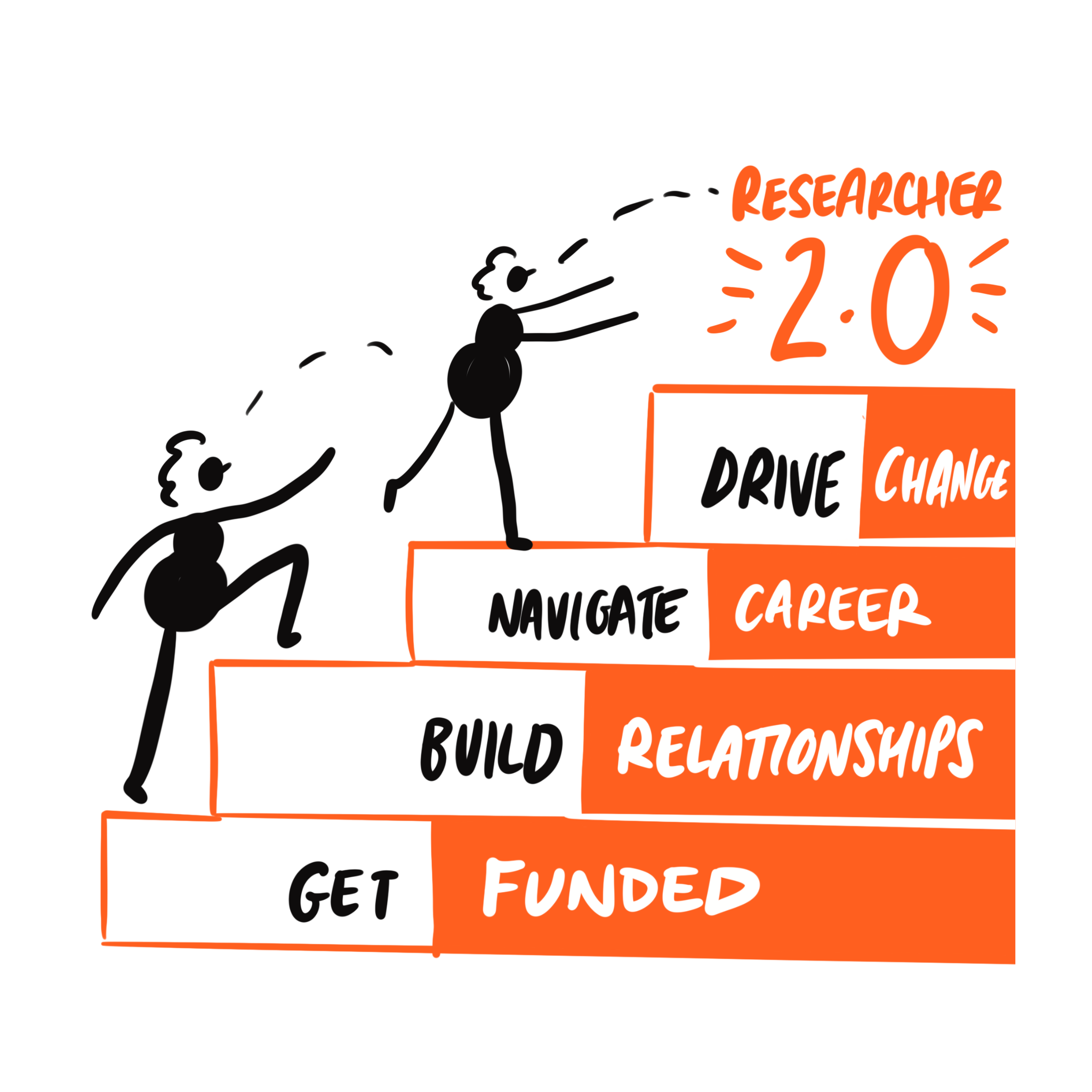
So what skills DOES the researcher of tomorrow need to:
-
Get funded
-
Build relationships
-
Navigate a complex career landscape
-
And drive change in policy, practice and public?
Here, we’ll look at the evidence behind what Researcher 2.0 skills look like, the three pillars of holistic researcher development training, and the 6 key skills every researcher needs to thrive in academia (and otherwise!) in 2026.
The evidence - what does Researcher 2.0 need?
It’s no longer enough to be a great publishing academic.
No one is reading journal articles anymore.
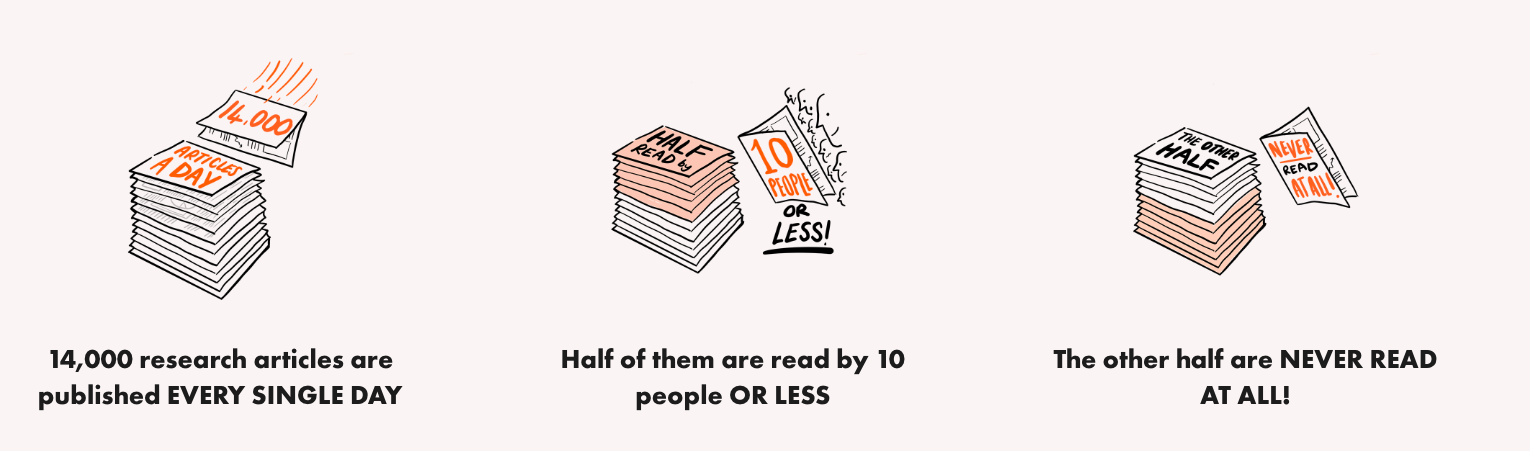
Approximately 14,000 research articles are published every single day (Bornman et al., 2022).
An average of ten people or fewer read half of them.
The other half?
NEVER READ AT ALL.
Whilst we recognise that publishing is important for academic career credibility, it’s not helpful for VISIBILITY. If audiences don’t know your work is out there, how can they possibly action it?
Rather than publishing or perishing, it’s about visibility so you don’t vanish.
Academics need the skills to communicate and present their work in ways that resonate with different audiences across different platforms to improve reach.
Researchers need a broader set of transferable skills - not just research expertise.
The UKRI’s New Deal Consultation in 2023 found that 1 in 6 respondents identified a strong need to develop researchers’ softer skills like communication, presenting, networking, collaboration, project management and critical thinking.
UKRI states that doctoral training should take a holistic approach, combining subject and methodological expertise with preparation for interdisciplinary collaborative environments, work across sectors, and career development.
The Vitae Researcher Development Roadmap also supports this broader view of a research skill set. It structures researcher development around:
- career confidence and progression
- engagement and influence
- research impact - including knowledge exchange, research visibility, communication and dissemination
- personal effectiveness
This shows that - backed by the UKRI - the ‘complete academic’ is a well-rounded communication, collaboration, and change professional, not just a subject matter expert.
Researchers need support to recognise their non-academic skills to work across sectors, and prepare for lives outside of academia if they choose it.
Prosper found that many postdocs are unaware of the non-academic skills they have developed as career skills, including communication, presentation, networking, and leadership. This matches employers’ six high-demand skills in communication, project management, leadership, commercial awareness, creativity and growth mindset.
The development need is then twofold: to develop these holistic skills researchers need to be successful inside and outside academia; and also to help researchers recognise and communicate these skills to potential collaborators and employers.
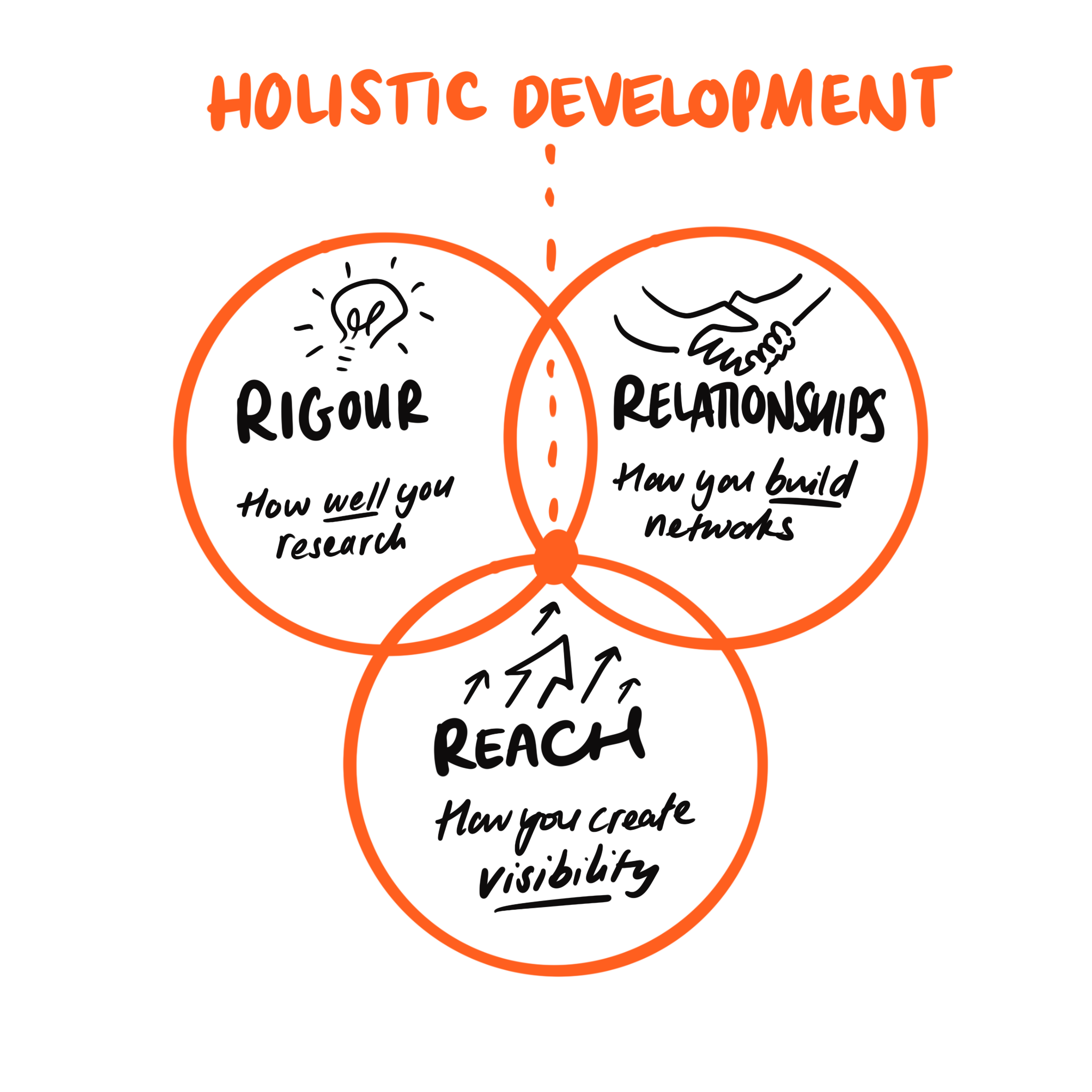
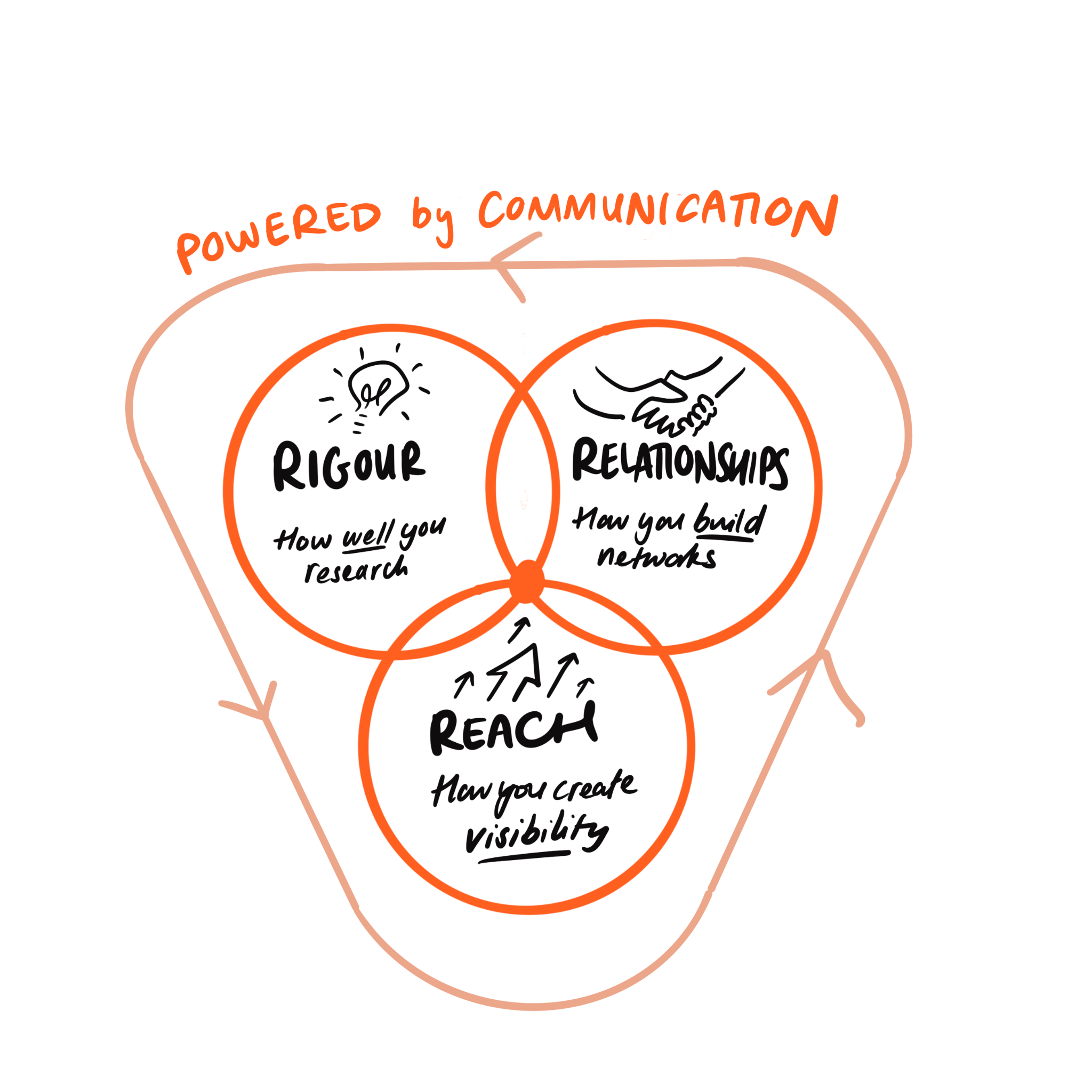
The 3Rs of Holistic Researcher Development
From the evidence, there are 3 key pillars that academics - from PhDs to Professors - need for their professional and personal development.
-
Rigour
Yes, you STILL need to be a great academic! If your research isn’t sound, then no amount of communication skills and relationship-building will solve that.
Methodological and subject-specific training, along with how to write journal articles and funding bids are still all important here. New skills like leveraging AI to streamline, speed up and even enhance the research process are now coming to the fore too - with academics needing to navigate new tools and ethics to harness AI effectively.
But, there should be an emphasis on how to work together with other disciplines and how to negotiate different methodological paradigms so academics become ‘experts who work well with other experts’. Rather than seeing academia as a solo sport - with funding more competitive than ever, working together becomes a competitive advantage.
-
Relationships
The more networked you are as an academic, the more opportunities you have.
Researchers must be able to speak the language and work with a diverse range of stakeholders, from other academics across disciplines, to industry, policy, practice and the public. This is necessary to build competitive collaborative funding bids; develop routes to impact for your work by engaging the people who can apply it and demonstrate change; and engage public contributors from the outset for work that is truly co-designed with patients and communities.
A big part of relationship building is learning how to translate your research into a solution for a specific problem that your audience needs to solve; and explaining your work clearly and succinctly (the opposite of how academics are taught to!). We’ll get to that later in this post.
-
Reach
The more visible, engaging and usable your research is, the higher the likelihood of driving change. Mobilising your knowledge across different communication modes - from presentations, to posters, to posting on social media - increases your research visibility, and your visibility as an expert. This could lead to new collaborations, invitations to speak, and even give evidence in parliament.
Communication skills from speaking, presenting, communicating visually, and creating knowledge products from animations and policy briefs, to toolkits become invaluable. By translating your research into understandable, usable outputs, it live beyond your paper and gets into the hands of those who can action it IRL. In other words, real-world application and impact.
The question that remains now, is how do research developer teams empower their researchers in each of the 3 pillars?
The ONE key skill to rule them all.
Communication is the bedrock skill of the 3Rs.
If you can’t communicate your work academically, you will fail.
If you can’t communicate your value to others, you won’t build good relationships.
If you can’t communicate your work in ways that beneficiaries can understand and use, you won’t drive change.
At Nifty, we’ve structured our academic-specific training with nearly 6000 researchers across 80 insittutions internationally around this principle:
Communicate it well, and they will come.
The 6 key skills
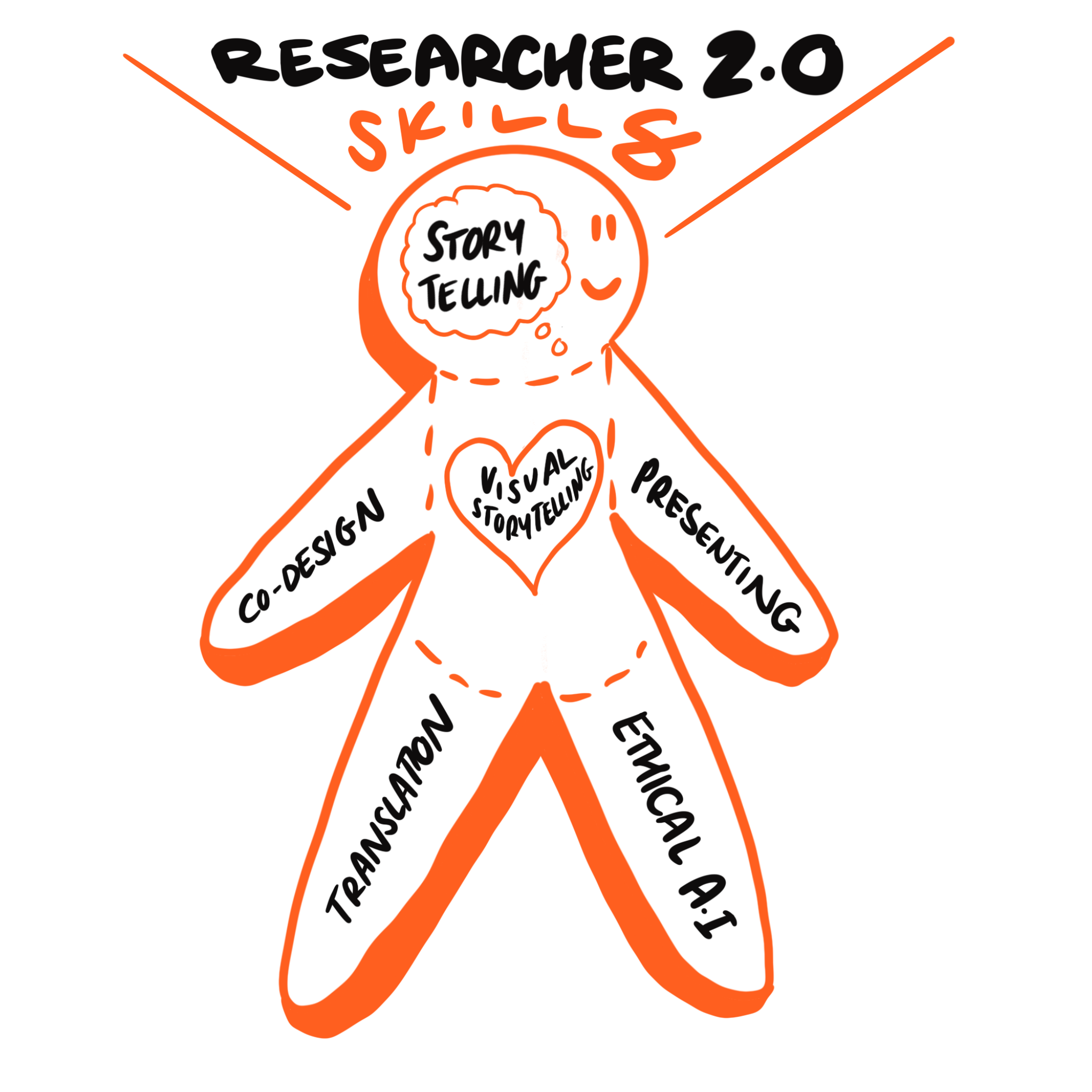
There are then 6 underpinning skills of a great communicator:
-
Storytelling
-
Visual storytelling
-
Presenting
-
Collaboration and Co-design
-
Research translation
-
Ethical AI proficiency
Storytelling makes your research understandable, 12 x more memorable, and relatable to audiences from senior leadership to the wider public. It’s a teachable skill - not reserved for actors and social media personalities.
Most academics just present the data. Story helps the data make sense.
Storytelling has been proven to enhance research impact and supercharge academic careers too.
Storytelling has been shown to engage stakeholders and influence decision-making, from environmental conservation (The Lenfern Ocean Project, 2022) to lobbying for policy change and regulatory reform (Fadallah et al., 2019). Stories also supercharge public engagement, boosting research accessibility, engagement and participation (Krauss et al., 2022; Gray et al., 2023). AND academics with storytelling skills attract more funding and collaboration opportunities than those that don’t (De Los Reyes, 2024).
Here’s some useful resources to help build storytelling skills:
-
Jeremy Connell-Waite - the Head of Storytelling at IBM, he has a treasure trove of free storytelling resources for you to enjoy!
-
Our free research rocket framework - helps you distill your research into one key story to engage policy, practice and public on just one page.
-
Our CPD-accredited Storyslingers Course - all the theory, frameworks and practical tools to get audiences to understand, use or fund your work
Visual storytelling makes research visible, tangible and easier to understand. This includes infographics, posters, animations, rich pictures, live illustrated summaries, to name a few.
Visuals are:
FAST – visuals are processed in 13 milliseconds versus six seconds for a sentence of text (Endress & Potter, 2014).
MEMORABLE – we are 65% more likely to recall visual information after three days than we are to recall text (Medina, 2009).
Drive ACTION – research articles with a visual abstract benefited from 170% more views that those without (Ibrahim et al., 2017), and research articles with an animated abstract benefited from 88% more views (Springer Nature, 2020).
So if you want to make your work visible, understandable and usable to diverse audiences, visual storytelling is a core skill to unlock.
For great free resources to help you, check out:
-
The Nifty Visual Comms database with links to templates, assets and training on how to use visual storytelling in research.
-
You can also check out our CPD-accredited Infotopia course - How to build infographics in under an hour with free tools too.
Presenting like a pro can influence full rooms of people, help you pitch for funding, and build collaborations with key stakeholders effortlessly.
The challenge is that most academic presentations fall into the ‘death by PowerPoint’ trap - 100s of slides, all crammed with text, with no narrative underpinning it.
This death by PowerPoint is a scientifically proven thing. Researchers at the University of New South Wales found that audience comprehension decreased when information was presented via word-stuffed PowerPoint slides (Kalyuga, 1999). Igoe (2022) supports this - they found that PowerPoint does not increase information transfer to your audience; it reduces it!
Learning to create clear and compelling PowerPoint narratives, visual and simpler slides, and present with confidence is the key here.
Check out Echo Riveira’s YouTube channel for academic-specific advice, or our
Presentation Pirates course for how to present engagingly WITHOUT PowerPoint.
Collaboration and co-design is fundamental to building research impact WITH communities, practice and policy, rather than doing to.
That’s broken down into skills like:
-
Active listening
-
Facilitation and inclusive design methods
-
Creative activities
-
Engaging presentations
-
Clear and accessible communication
-
Project and relationship management
Which when combined together, can feel overwhelming to develop! Our Critical Inking course address these in one place - equipping you with the creative facilitation skills to run inclusive co-design and public engagement events.
You can check out the free resource version here.
And the course itself here.
Research translation means converting your research into outputs that are usable and engaging for beneficiaries - like translating your health research into a practitioner toolkit for example. The challenge is, nowhere in your academic training are you taught HOW to do this - you just write a lengthy PDF of all your findings, add the word ‘toolkit’ to the front of it, and hope for the best ;).
Good research translation, starts by understanding who the audience are you want to use your research, and designing the messaging, format and dissemination method around their needs specifically.
Some tools to help you build that skill:
-
Our ‘So What Kit’ to help you decide what knowledge translation product you actually need for your audience
-
Our Nifty Knowledge Canvas to go from research idea to fully functional toolkit
-
Our Research to Reach: How to turn your research into toolkits and training course
Finally, navigating how to use AI ethically is the final piece of the communication puzzle. Whether it’s finding the right research papers for a literature review, critiquing your funding application, writing your methods section or creating an academic poster, there’s an AI tool to help you. BUT, data sharing, institutional AI policy and the idiosyncracies of all the possible tools available make using AI a potential pitfall.
A great place to start on your journey is to check out Andy Stapleton’s YouTube channel - an academic who teaches other academics how to use AI!
Then, for all the latest and greatest tools to help you, check out Futurepedia.
Finally, when you are ready to put it into practice, check out our Academ:AI course that walks you through the ethical frameworks, AI tools, and prompting techniques to help you communicate your research creatively without the ethical headaches.
Researcher 2.0 is out there - a maestro communicator, collaborator and change-maker who knows their worth, their skills, and their unique impact gift to the world!
Need a little help building them?
Get in touch to find out more about our CPD-accredited, academic-specific communication training.